Device Details
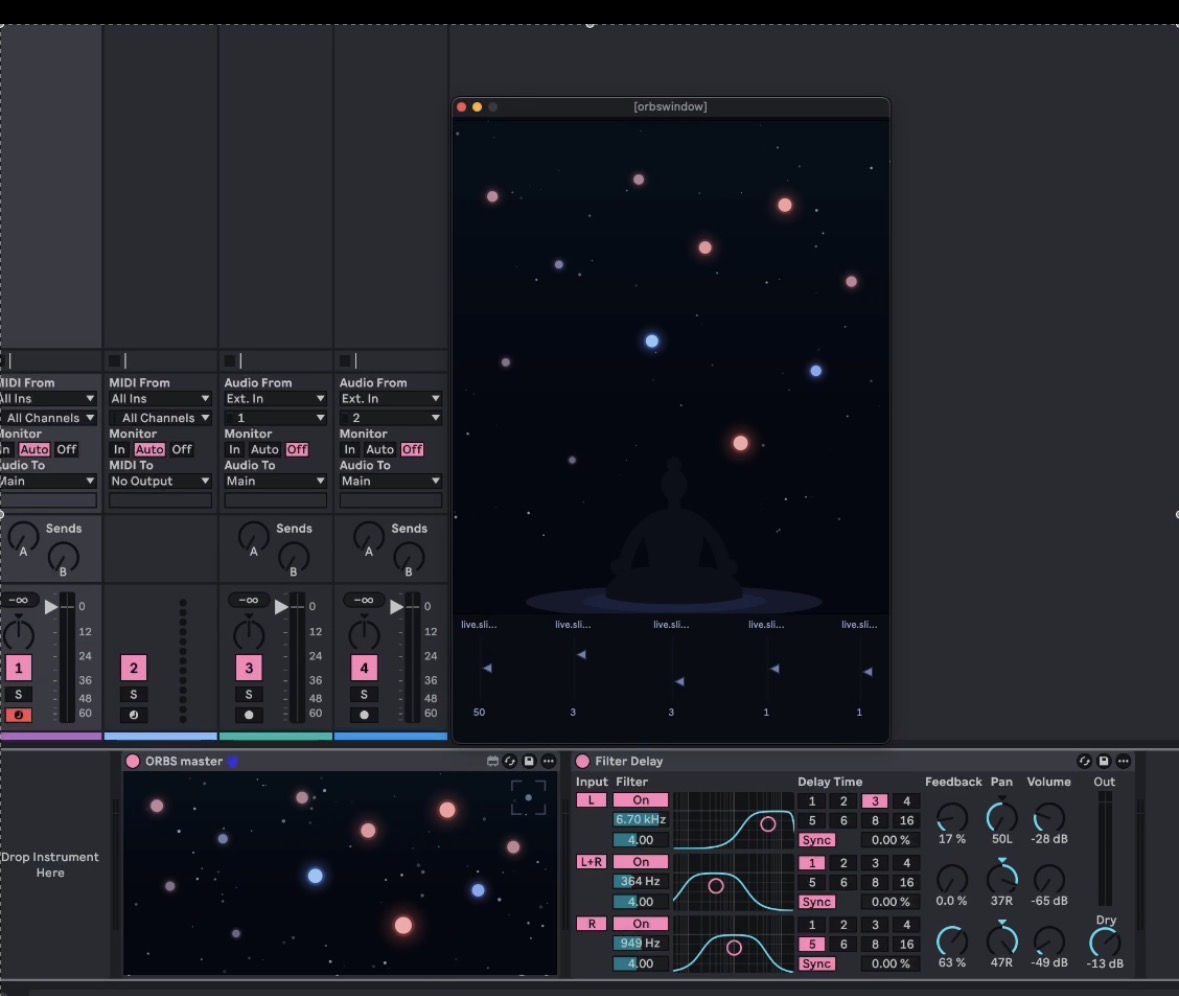
Overview
| Name | Version: | ORBS 1.0 |
| Author: | pranasound |
| Device Type: | Audio Effect |
| Description: | Most modulation loops. An LFO returns to where it started; a envelope resets; a random source jumps without memory. Orbs does neither. It is a numerical model of a chaotic analogue circuit — three coupled integrator rings, each with a bistable switching element — and its motion is genuinely aperiodic. There is no cycle length. Two identical sessions will not produce identical results. The three rings run at deliberately mismatched speeds. Torpor completes an orbit in fifteen to thirty seconds. Apathy takes a minute or more. Inertia takes over half an hour, and on any normal timescale it barely appears to move at all — which is precisely what makes it useful for the slow, structural changes that are almost impossible to automate convincingly by hand. Each ring produces three outputs, plus two more from a differential stage that combines all three. Eleven signals in total, each independently mappable to any automatable parameter in Live, on any track. Click an orb, click a target, and it begins. Double- click to release it. Modulation is bipolar and centred on wherever you leave the target parameter. Set a dry/wet to twenty-five percent and Orbs will swing above and below twenty-five percent. The knob position is the centre of the motion, not the floor. Two controls shape the character of each ring. Gravity determines how tightly it holds its orbit — low values glide, higher values snap between extremes and dwell there. Pull determines how much the rings interfere with one another; at zero they are independent, and raising it lets them disturb each other's paths. A global Drift Rate scales everything from a sixth of the calibrated speed up to six times faster, on a logarithmic curve so the slow end is as playable as the fast end. All five controls are themselves automatable and mappable. Orbs can modulate Orbs. F E A T U R ES 11 independent modulation outputs — three rings × three outputs, plus differential positive and negative Genuinely aperiodic — no loop, no cycle length, no reset Three time scales — approximately 15–30 seconds, 60–90 seconds, and 30–40 minutes per orbit Map anything — any automatable parameter, any device, any track Bipolar modulation — centred on the target's current position Click to map, double-click to unmap — directly on the orbs themselves Live visual feedback — colour shows polarity, size shows magnitude Fully automatable controls — Orbs can be modulated by anything, including itself Negligible CPU — 40 Hz control rate, no audio-rate processing |
Details
| Live Version Used: | 12.0.5 |
| Max Version Used: | 8.6.2 |
| Date Added: | Aug 11 2026 13:36:38 |
| Date Last Updated: | No Updates |
| Downloads: | 0 |
| Website: | https://gumroad.com/products/pdfgvq/edit |
| ⓘ License: | None |
Average Rating
Log in to rate this device |
-n/a- |
Login to comment on this device.
Browse the full library